
Height
~ 80 – 120 cm, 3 – 5 ft
Weight
~ 3 – 6.5 kg, 6.5 – 14 lbs
Population
827,000
Subspecies
canadensis – Lesser tabida – Greater pratensis – Florida pulla – Mississippi nesiotes – Cuban




Range
The two migratory subspecies (Lesser and Greater) are distributed across a broad breeding range in the... (click to read more)
northern U.S. and Canada as well as eastern Siberia with wintering grounds in the southern United States and northern Mexico. The three non-migratory subspecies (Mississippi, Cuban and Florida) have restricted ranges in the southern United States and Cuba. Note that we recognize five Sandhill Crane subspecies per the IOC Master list v 8.2. The Canadian subspecies rowani was found in 2001 to have insignificant genetic differentiation and is included in the Greater subspecies tabida (Rhymer et al, 2001).
fun fact
A crane fossil found in Nebraska from the Pliocene period (5.3-2.6 million years ago) appears structurally identical to the modern Sandhill Crane, making it one of the oldest known bird species!
Trend
Eastern and Central Valley populations increasing; Mid-continent, Pacific Coast, Lower Colorado River Valley and Rocky Mountain populations stable or increasing; Florida population stable to perhaps increasing; Cuba population stable to decreasing; Mississippi population decreasing
Status
IUCN: LC; Cites Appendix II;
ssp. pulla: Cites Appendix I & ESA: E;
ssp. nesiotes: Cites Appendix I & ESA: E
Identification
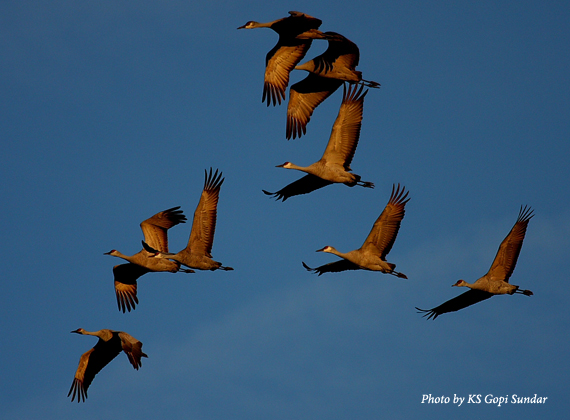
Adults – red patch on forehead, legs black, plumage varying shades of grey and brown, body size varies by subspecies; juveniles – cinnamon-brown feathers
Did you see a banded Sandhill Crane? Report your sighting.
Diet
Plant tubers, grains, small mammals, amphibians, reptiles, insects and grain such as corn.
Threats
Conversion of grasslands to agriculture, afforestation and other development, habitat loss and conflicts with agriculture.
Our Plan
Conduct applied research on issues important to the future of Sandhill Cranes, and develop creative solutions to emerging conservation challenges.
We are:
- Promoting the use of deterrents for those farmers who have experienced crop damage from cranes.
- Assessing the impacts of hunting on Sandhill Cranes and the illegal shooting of Whooping Cranes and sharing that information with stakeholders and decision-makers.
- Monitoring impacts of power line and wind turbine development and collaborating with the industry to develop and implement strategies that reduce risks to cranes.
- Investigating how habitat changes affect crane reproductive success potential.
How You Can Help
- Become a crane counter! The International Crane Foundation coordinates the Annual Midwest Crane Count each April in Wisconsin, Minnesota, Iowa, Illinois, Indiana and Michigan.
- Adopt a Sandhill Crane
- Become a member of the International Crane Foundation.