
SPECIES: Grus monacha
HEIGHT: ~ 100 cm, 3 ft
WEIGHT: ~ 3.75 kg, 8 lbs
POPULATION: 14,500 – 16,000
TREND: Increasing
STATUS: IUCN: VU; Cites Appendix I; ESA: E; CMS I, II
IDENTIFICATION
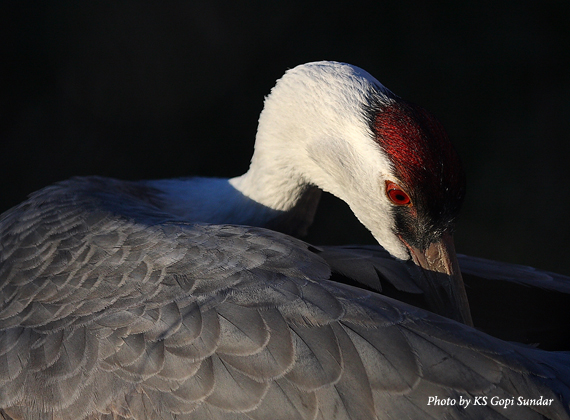
Adults – red patch on forehead, white head and neck, slate-grey body plumage, wingtips, tail and legs are black; juveniles – tan head, slate-grey body plumage.
RANGE
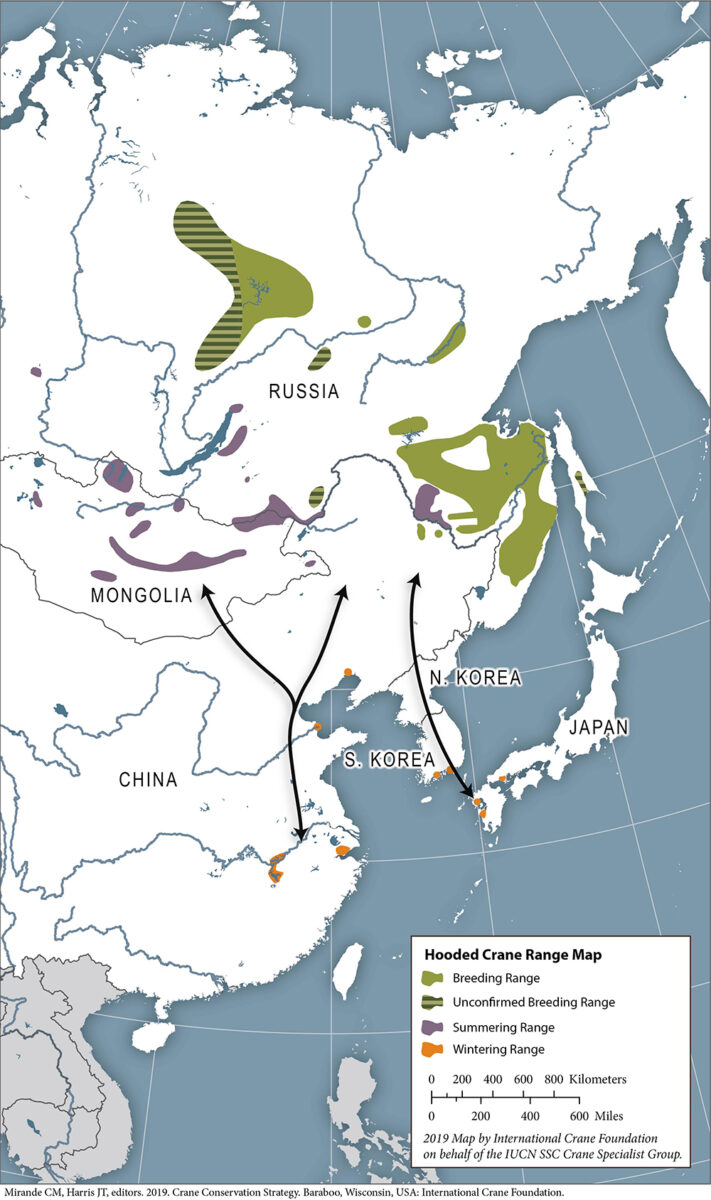
The breeding grounds of this species are in central and southeastern Russia and northern China. Non-breeding flocks occur in the Russia-Mongolia-China border region. More than 80% of Hooded Cranes spend the winter at the Izumi Feeding Station on the Japanese island of Kyushu. Small numbers are found at Yashiro in southern Japan, in South Korea and at several sites along the middle Yangtze River in China.
DIET
Aquatic plants, berries, insects, amphibians, roots, rhizomes, seeds, grass and small mammals. At artificial feeding stations in Korea and Japan, Hooded Cranes eat rice, wheat and other cereal grains.
CALL
Listen to Hooded Crane calls:
 Contact Call | A soft, purring call expressing reassurance and location.
Guard Call | A sharp, single call expressing alarm.
Unison Call | A duet performed by a pair, to strengthen their bond and protect their territory.
THREATS
High risk of disease outbreak in the concentrated flocks at the winter feeding stations, habitat loss, illegal take, pollution and environmental contamination, collisions with power lines and changes in agricultural practices.
OUR PLAN
Our work builds on the strong cultural ties to cranes in East Asia, to engage local communities and policy makers in the conservation of protected areas and their surrounding landscapes, including:
Ensure healthy populations of Hooded Crane populations in the Amur-Heilong Basin of Russia and China. We are:
- Supporting the development and implementation of water management plans that sustain crane habitats and preserve wetlands for wildlife, flood control, enhancement of water quality, fisheries and other harvests important to people at Zhalong, Momoge, Xianghai, Tumuji, Muraviovka and other key crane wetlands.
- Developing pilot projects in China and Russia that demonstrate community involvement with wetland conservation.
- Promoting cooperative research efforts between crane conservationists in Mongolia and the Amur-Heilong basin of Russia and China.
- Conducting environmental education activities among communities and stakeholders affecting critical crane habitat to increase local and national pride and commitment to conservation action.
Supporting increasing winter populations of Cranes and maintaining the extraordinary diversity of other waterbird species in Poyang and nearby lakes in southeastern China. We are:
- Determining the effects of different water management scenarios on cranes and their aquatic plant food base.
- Promoting ecosystem approaches to management, including strategies to manage degradation caused by water infrastructure and economic development within its basin.
- Collaborating with Chinese agencies, researchers and local communities to demonstrate how fisheries management and crane protection go together.
- Supporting efforts by management agencies and partners to identify and restore alternative wintering sites for cranes in southern China.
Learn more about Hooded Cranes: