
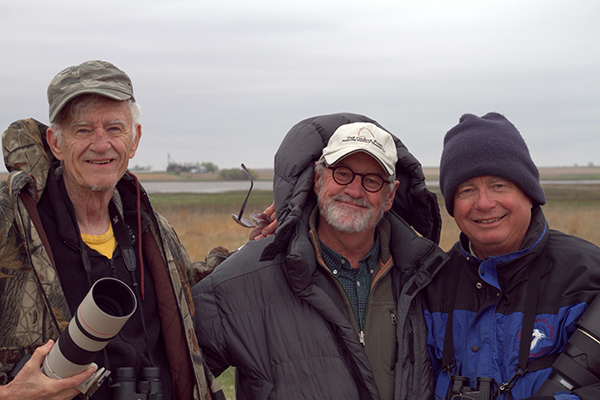
Every March for more than four decades, I have made my way to Nebraska to experience the gathering of perhaps the planet’s largest gathering of cranes. In late March of 2020, this was my final trip of the year as the pandemic swept over this continent. I safely returned to the same area this spring to view a portion of more than a million Sandhill Cranes, and at the same time, I had my final visit with one of the planet’s great ornithologists and lover of cranes, Paul Johnsgard. Two months later, in late May, at the age of 89 and with over 100 book titles and a litany of scientific and fictional publications, Paul passed away.
Paul’s long and productive career was based at the University of Nebraska, where he taught ornithology and inspired thousands of students. He had the amazing ability to craft his observations of birds and those of others into comprehensive and easily read literature. For anyone wanting an update on the world’s waterfowl, grouse, shorebirds, hummingbirds, cranes, pheasants, raptors, bustards, cormorants, pelicans, trogons and the natural history and human history of the Great Plains, a Johnsgard publication is a must. View the Paul Johnsgard Collection at the University of Nebraska.
“There is a magical time that occurs each year in the heart of North America when the river and the season and the birds all come into brief conjunction.” ~ Paul Johnsgard
The outstanding nature photographer Tom Mangelsen was one of Paul’s students. But Tom was more interested in capturing the great outdoors on film than on paper. Once when Paul, Tom and I were reminiscing about life, Paul commented that Tom was his most successful but academically worst student. Paul’s warmth and intellect, both in person and on paper, endeared him widely. And one of my personal highlights of the year was meeting Tom and Paul in the company of cranes in Nebraska in March.
Jane Goodall is a close friend of Tom’s and spends a week with him at his retreat beside the Platte in the heart of Crane Country. In 2014, we celebrated Jane’s 80th birthday in the company of cranes. By chance, I discovered 10 Whooping Cranes resting on a small wetland just south of the Platte and was anxious to share the finding with Jane, Tom and Paul. The next day, Jane was committed to meeting with her publisher. I served as the driver for the entire day, getting the two photographers – Paul and Tom – in the best place for pictures. Paul’s close friend, Linda, joined us and brought along sandwiches and drinks. I cherish the memory of that special day shared with such special friends. On Jane’s birthday, I had to leave. But Tom brought her to see the Whooping Cranes as part of the celebration of that special day.
When Paul and I shared time together in late March, his frailty indicated that every day was a bonus. With a smile and a nod, he stated that soon he would be in the sky with his beloved Sandhill Cranes.
 Story submitted by George Archibald, Co-founder and Senior Conservationist.